Home to some of the country’s most historic producers, many with centuries of winemaking behind them, Rioja today is also being reshaped by a new generation of growers and winemakers. These producers are rethinking established conventions, focusing more closely on vineyard expression, and exploring a broader range of styles than ever before. The result is a region of remarkable diversity, where classic and contemporary approaches sit side by side.
Stretching roughly 75 miles from north-west to south-east along the Ebro Valley, Rioja’s patchwork of landscapes, climates and soils play a crucial role in shaping its wines, making it far more complex than its traditional classifications alone might suggest.

Geography
Rioja is traditionally divided into three sub-regions:
- Rioja Alta (west): Higher altitude vineyards (up to ~800m) influenced by Atlantic conditions. Wines tend to be fresher, more structured and age-worthy. Haro remains the historic heart, home to many of the region’s most famous bodegas.
- Rioja Alavesa (north, in the Basque Country): Shares many similarities with Alta but often produces wines of notable purity, perfume and precision, particularly around villages such as Laguardia and Elciego.
- Rioja Oriental (east): Warmer and more Mediterranean, where garnacha thrives, producing fuller, riper styles.
Increasingly, however, producers are looking beyond these broad zones to focus on villages and individual vineyard sites, highlighting places such as San Vicente de la Sonsierra, Labastida or Tudelilla on labels. To support this approach, further classifications are now permitted on labels:
- Vino de Pueblo (Village Wine): introduced in 2024 refers to wines from a specific village allowing producers to cite the specific village from which they come – with 144 different villages approved.
- Viñedo Singular: introduced in 2017 and recently updated, this classification highlights single plots with an approved unique terroir which must come from old vines and be hand-harvested.
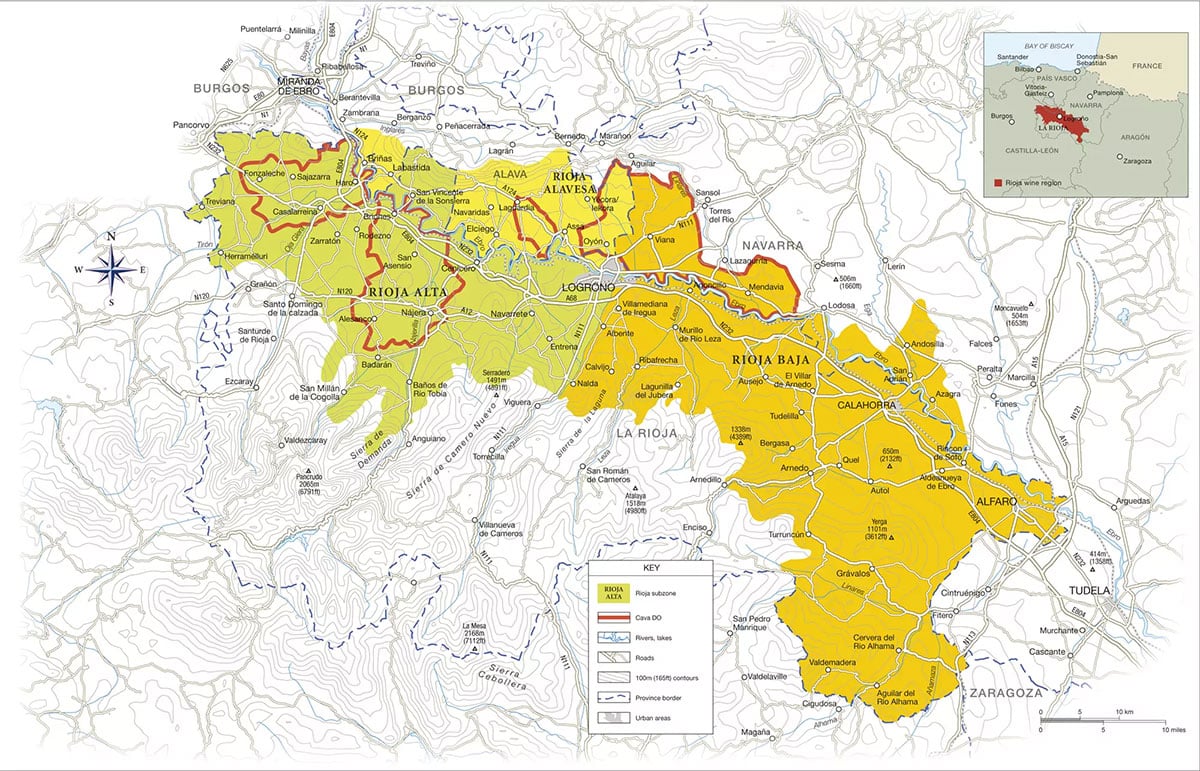
View the map of Rioja as a PDF
The grapes
Tempranillo remains the backbone of Rioja, prized for its perfume, structure and affinity with oak-ageing, it can make wines from anything from light and fruity, to more structured and tannic. A typical crianza will be a blend of mostly tempranillo with some garnacha to add body and spice. Graciano (a fine Rioja speciality, prized for its aroma and acidity) and mazuelo (the Riojan name for carignan which gives tannin and colour) are also used to complement the final blend. Garnacha is being taken increasingly more seriously as it adapts very well to heat in a warming climate.
Winemaking – the different styles:
The best way to choose Rioja is to find a bodega that makes the style of wine you like as modern-day Rioja offers such a range, varying from the very oak-driven classics, to more powerful, international styles alongside a growing number of very artisanal, site-driven examples. With so many emerging producers working in increasingly different ways I think it can be helpful (at least for now!) to consider Rioja styles as falling into two broad camps:
1. Classic – Traditional and Modern
Traditional Classic: Defined by generous oak ageing. spice, classic Rioja ranges from easy-drinking crianzas (think The Society’s Crianza and Navajas) to complex, age-worthy reservas (think Tondonia and La Rioja Alta) wines, often with tobacco, dried fruit, and savoury notes. Usually ready to drink on release and favouring American oak during the ageing process following the classic ageing classifications.
Modern Classic: built on traditional foundations but add greater power and structure, sometimes using French oak or a mix with American oak. These wines often benefit from further bottle ageing and reflect a balance between heritage and evolution, maintaining classic ageing frameworks while appealing to contemporary, international tastes (think CVNE, Contino, Muga).
2. ‘Nuevo Viejo’ (The new old)
A term coined by Tim Atkin MW, this literally translates to ‘new old,’ an increasingly important movement focusing on vineyard expression over cellar influence. These wines often place fruit and terroir at centre stage, showing minerality, energy and verve, and may require bottle ageing despite lower overt oak influence. The emphasis is on site, altitude and soil and many techniques and practices in fact pre-date the French influence which shaped the more traditional styles, hence the term ‘nuevo viejo’. (Think Eguiluz in Abalos, Sierra de Toloño in Villabuena de Alva).

Rioja Blanco: White Rioja has undergone the most dramatic evolution, with producers now applying the same care as they do to reds, creating a much broader stylistic range. Alongside fresh, fruity entry-level styles, there’s a clear return to more traditional methods – oak, oxidative ageing, and lees work – yielding textured, complex, and gastronomic wines with creamy, savoury depth. Viura leads this shift, excelling with these techniques and producing some of Spain’s most versatile food-friendly whites, often blended with malvasía, garnacha blanca, or tempranillo blanco. Our Society’s Exhibition Blanco is a great example of a textured, oily, complex white.
>> Read more about my thoughts on innovation in Rioja here
Age classifications – (Crianza, Reserva, Gran Reserva)
Rioja’s traditional ageing terms which are still widely used, legally defined and generally used by more classic producers.
- Cosecha / Joven: Little or no oak ageing
- Crianza: Minimum two years ageing (including at least one year in oak for reds)
- Reserva: Minimum three years ageing (including at least one year in oak)
- Gran Reserva: Minimum five years ageing (including at least two years in oak)
These are minimum requirements, and many producers exceed them.
These labels are now less predictive of style than they once were, as some of the most site-driven wines deliberately sit outside this system, some opting for the Vino de Pueblo or Viñedo Singular classifications instead.